TL;DR:
- Poultry is 165°F, always. Ground meat is 160°F. Whole cuts of beef, pork, veal, and lamb are 145°F with a 3-minute rest.
- Those are safety floors, not flavor targets — pulled pork and brisket go to 195–203°F because that’s when collagen breaks down, not because 145°F isn’t safe.
- Pull your meat 5–15°F under your target before it rests. Carryover cooking closes the rest of the gap on its own.
For most of human history, “done” was a guess. You poked it, cut it open to check the color, watched for juices running clear, and hoped whatever signal you’d learned from your parents or your pit crew actually meant something. It mostly didn’t — carryover heat, resting time, and the fact that meat color changes at wildly different temperatures depending on the cut all conspire to make “looks done” a bad proxy for “is safe.” A thermometer replaced the guessing with one number, and the USDA and FDA have spent decades studying exactly which number kills which pathogen in which protein.
Here’s that chart. Bookmark it, screenshot it, whatever you need to do. Then keep reading, because the part every other version of this chart leaves out is the part that actually matters once you’re smoking instead of just cooking: where these numbers stop being about safety and start being about texture, and why the two are easy to confuse.
Table of Contents
- The Chart
- The Difference Between Done and Safe
- Carryover Cooking and Why You Pull Early
- Where to Put the Probe
- If You Missed the Mark
- The Two Thermometers Worth Owning
- Frequently Asked Questions
The Chart
| Food | Safe minimum internal temp | Notes |
|---|---|---|
| Beef, pork, veal, lamb — steaks, chops, roasts | 145°F | Rest at least 3 minutes before cutting or eating. The rest is part of the safety math, not optional. |
| Fresh (raw) ham | 145°F | Same rule as any whole cut. |
| Precooked ham (USDA-inspected plant) | 140°F | Reheating, not cooking. Repackaged outside the original plant, treat it like leftovers — 165°F. |
| Ground beef, pork, veal, lamb | 160°F | Grinding moves surface bacteria into the interior, which is why ground meat needs a higher number than a whole cut. |
| All poultry — whole, parts, ground | 165°F | No exceptions, no ranges. Breast, thigh, wing, ground turkey, it’s all 165°F. |
| Stuffing and casseroles | 165°F | Cooked inside the bird or out. |
| Egg dishes (quiche, frittata, casseroles) | 160°F | Plain fried or scrambled eggs: cook until the white and yolk are firm. |
| Fish with fins | 145°F | Or use the visual check: flesh turns opaque and separates easily with a fork. |
| Shrimp, lobster, crab, scallops | No set number | Done when the flesh is pearly or white and opaque throughout. |
| Leftovers and casseroles (reheating) | 165°F |
That’s the official version, straight from USDA FSIS and the FDA Food Code. Every number on it is a floor, not a target. That distinction matters more in a smoker than anywhere else in your kitchen.
The Difference Between Done and Safe
145°F will kill what needs killing in a pork shoulder. It will also leave you with something closer to a pot roast than pulled pork — tight muscle fibers, no shred, no bark that’s rendered down into something worth eating. You take pulled pork to 195–203°F not because 145°F isn’t safe, but because that’s the range where collagen and connective tissue finally break down into gelatin. Same story with brisket: safe at 145°F, genuinely good somewhere around 203°F, when a probe slides into the point with about as much resistance as room-temperature butter.
Safety and quality are different questions, and only one of them has a legal minimum.
Chicken is where this trips people up the most. Breast meat is fine at 165°F — lean muscle, not much connective tissue to break down, so there’s no reason to push it further. Thighs and drumsticks are a different animal. They’re safe at 165°F too, but I take dark meat to 175–180°F on the smoker because the texture at 165°F is close enough to rubbery that it’s not worth defending. That’s my opinion, not a safety recommendation, and I’ll draw the line clearly right here: don’t go past 165°F on chicken breast chasing the same logic, because there’s no connective tissue reward waiting for you on the other side — just dry meat.
Ribs don’t get a number at all, which surprises people. There’s no single internal temp that reliably signals “done” on a rack of ribs, because the meat is thin and unevenly distributed around the bone. Pitmasters use the bend test instead — pick the rack up with tongs at one end and watch the surface crack when it bows. That’s a texture call, and it comes after the meat has long since cleared any safety threshold.
Salmon is the one place I’ll admit to going below the official number, and I want to be straight about it instead of pretending there’s a workaround. The FDA lists 145°F for fish. I pull smoked salmon closer to 125–130°F because I don’t like the chalky, fully-cooked texture that shows up past that point — plenty of people who’ve smoked a lot of fish do the same thing. That said, going below the FDA minimum is a real tradeoff, not a trick, and it matters more with fish than with beef or pork given how it’s typically sourced and handled. If that gap makes you uncomfortable, don’t take it — cook to 145°F and don’t let anyone talk you out of it.
Carryover Cooking and Why You Pull Early
Meat keeps cooking after it comes off the heat. The outer layers are hotter than the center, and that heat keeps migrating inward by conduction even after the heat source is gone — which means if you wait until your target temp shows on the probe, you’ve already overshot it. ThermoWorks has measured this in detail, and the rise scales with the size of the cut and how hot it was cooking:
- Thin steaks (under an inch): 3–5°F rise
- Standard steaks and chops: 5–8°F
- Thick roasts, whole chickens: 10–15°F
- Large cuts like brisket and pork butt, cooked low and slow: often just 5°F, since there’s less thermal mass differential by the time they’re done
Pull steaks about 5°F under your target. Pull a standard roast 10°F under. Pull a big one — turkey, brisket, a pork butt — as much as 15°F under and let the rest do the last stretch of work. This is also the reason resting isn’t optional on anything bigger than a burger patty: cut into a rested roast and the juices stay put. Cut into one straight off the grate and they run out onto the board instead of back into the meat.
Where to Put the Probe
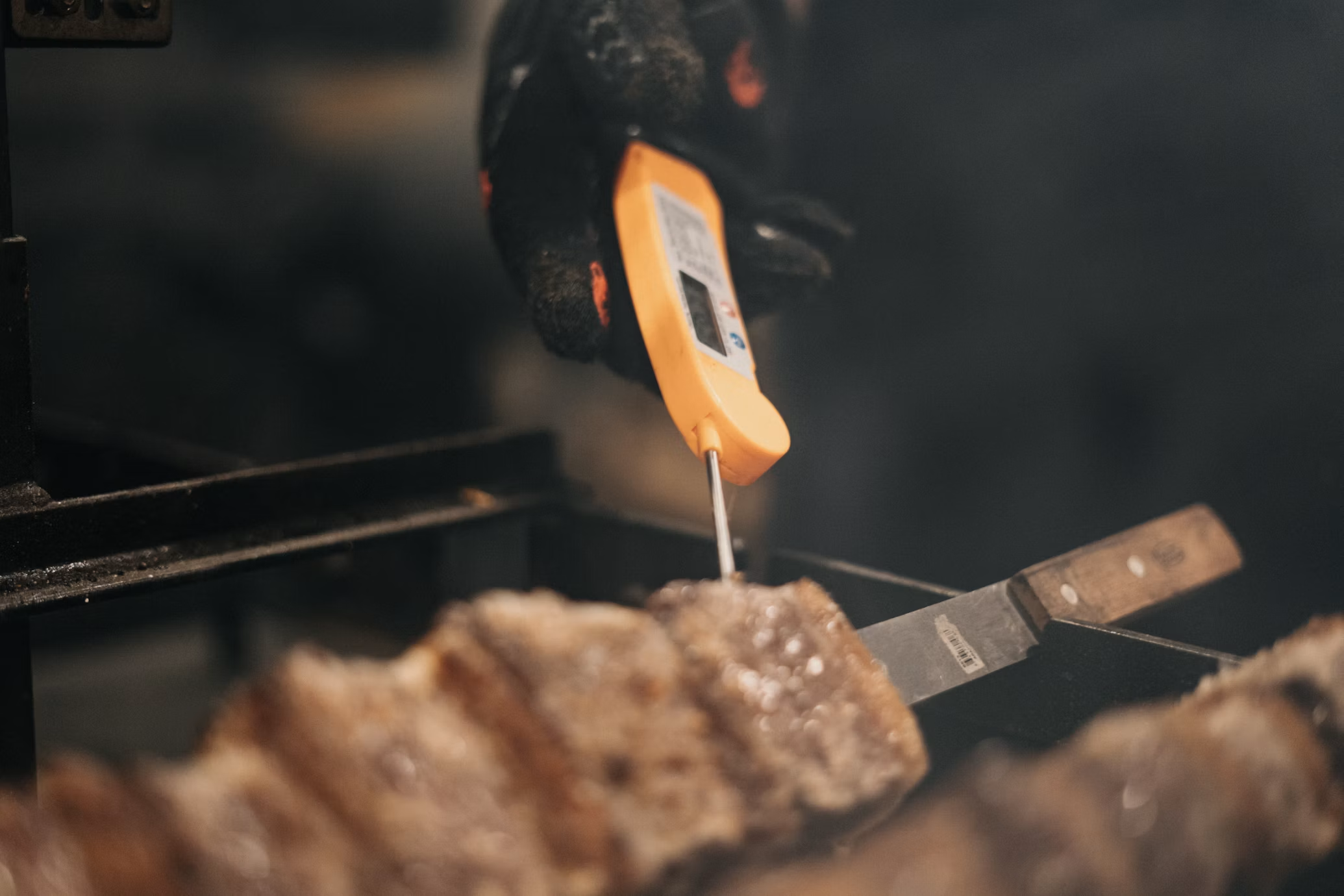
Thickest part of the cut, away from bone, fat, and gristle — all three read hot or cold relative to the actual muscle and will throw your number off. On a whole chicken, that’s the thickest part of the breast or the inner thigh, not touching the bone. On a steak, insert from the side, not the top, so the tip sits in the center rather than skating along one face.
Give the reading a few seconds to settle before you trust it — an instant-read thermometer is fast, but “fast” still means a couple seconds of the display climbing before it holds steady. And if you’ve owned a thermometer for more than a season, dunk it in ice water once in a while. It should read 32°F. If it doesn’t, every number on this chart is only as good as your last calibration.
If You Missed the Mark
Chicken that’s fully at 165°F but still looks pink near the bone isn’t undercooked — that’s usually pigment from the bone marrow leaching into the surrounding meat, a cosmetic issue the USDA has been fielding calls about for years. Trust the thermometer over your eyes here.
If you overshot a brisket or a pork butt and it’s drying out, wrap it in foil with a splash of stock or a few pats of butter and let it rest, wrapped, in a towel-lined cooler for an hour. It won’t undo the damage completely, but it recovers more moisture than you’d expect. If you pulled something too early and it’s short of its target, the fix is even simpler: put it back on the heat. Nothing here is a soufflé. A brisket that goes back on for another 45 minutes doesn’t know it was ever interrupted.
The Two Thermometers Worth Owning
You need two different tools for two different jobs, and trying to make one do both is where most people go wrong. Quick disclosure before I get into specifics: the two links below are affiliate links. If you buy through either one, Smoke Insider may earn a small commission at no extra cost to you. I own the Thermapen; I don’t own the CHEF iQ Sense, which is exactly why I’ve labeled it that way below.
For a spot check
Is this steak actually done, is that chicken thigh really at 175°F — for a quick spot check, you want an instant-read. I’ve used a Thermapen ONE for years and it’s never given me a reason to look elsewhere for that job: ThermoWorks rates it at ±0.5°F accuracy with a roughly one-second read, and mine has held up to that. ThermoWorks has since moved the ONE to closeout pricing (you can occasionally find it well under $100) in favor of the new Thermapen NANO, which reads even faster — about 0.4 seconds — for around $119. Same accuracy spec, same brand, just quicker off the mark.
For a long smoke
An instant-read isn’t the right tool at all for a long smoke — every time you open the lid to check a brisket, you’re losing heat and smoke for a number you could’ve had without lifting the lid. That’s the job for a leave-in wireless probe, and here’s the one honest caveat I’ll give you: I haven’t run a CHEF iQ Sense through a full cook myself, so take this as a spec-sheet recommendation, not a field report. On paper it’s a strong one — multiple ultra-thin probes, each carrying several internal sensors that automatically report the single coldest point in the meat rather than one static reading, WiFi range through its charging hub that isn’t capped by Bluetooth’s line-of-sight limits, and 40-plus hours of runtime off a 10-minute charge. Pricing starts around $99.99 depending on probe count. If you’ve used one through an actual cook and it either backs this up or doesn’t, I’d like to know.
Frequently Asked Questions
Is 145°F really safe for pork now, or is that outdated advice?
It’s current. The USDA lowered pork’s safe minimum from 160°F to 145°F in 2011 after research showed trichinosis had been effectively eliminated from the commercial pork supply. The 3-minute rest afterward is part of that safety math, not an optional step — skip it and you’re not actually hitting the tested standard.
Why does poultry need 165°F when other whole cuts stop at 145°F?
Salmonella and campylobacter, the pathogens of concern in poultry, need a higher temperature to be reliably killed than the bacteria typical of beef or pork. There’s no shortcut here — breast, thigh, and ground poultry all share the same 165°F floor regardless of cut or cooking method.
Do I actually need to rest meat after it hits temperature?
Yes, for anything larger than a thin patty. Resting lets carryover heat finish its work and gives muscle fibers time to relax and reabsorb juices that would otherwise run out onto the cutting board. The USDA’s 3-minute minimum for whole cuts is a safety figure; for bigger cuts like brisket, a longer rest is also a quality decision.
Why do pitmasters take brisket and pulled pork so far past the safe minimum?
Because 145°F is a safety floor, not a texture target. Collagen and connective tissue don’t break down into gelatin until well past that point — typically 195–203°F — which is what turns a tough cut into something that shreds. Below that range, the meat is safe to eat but far tougher.
Is medium-rare ground beef safe?
No. Grinding distributes any surface bacteria throughout the meat, so ground beef needs to hit 160°F all the way through — there’s no equivalent to a rare steak here, where the interior was never exposed. A pink center in a burger isn’t a style choice; it’s a temperature that hasn’t gotten there yet.
That’s the chart I actually use, taped inside a cabinet door that’s gotten too grease-stained to read anymore. If you pull pulled pork at a different number than I do, or you smoke your salmon colder or hotter than 125°F, I’d genuinely like to hear about it.
Free Cheat Sheet
Smoking Times & Temps Cheat Sheet
Pit temps, pull temps, and total time for the cuts you smoke most — one page, worth printing.